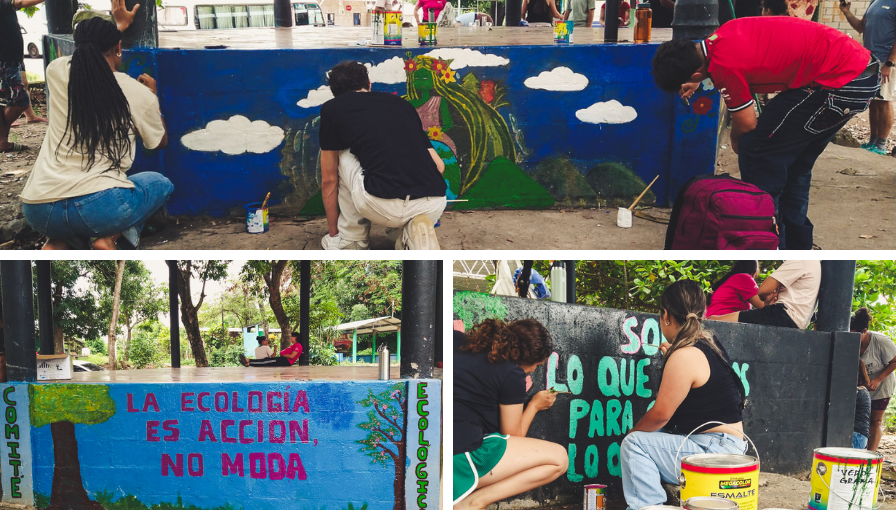
The murals on the kiosk
When I think about El Papaturro from Honduras, the first image that comes to mind is the small plaza in my community. There is a kiosk there with murals about the rivers, the trees, and caring for the environment. They were created by the Ecological Committee, the group I have been part of since 2021 and now coordinate. That image holds much of what I carry with me: my community, what I have learned there, and the responsibilities I have chosen to take on.
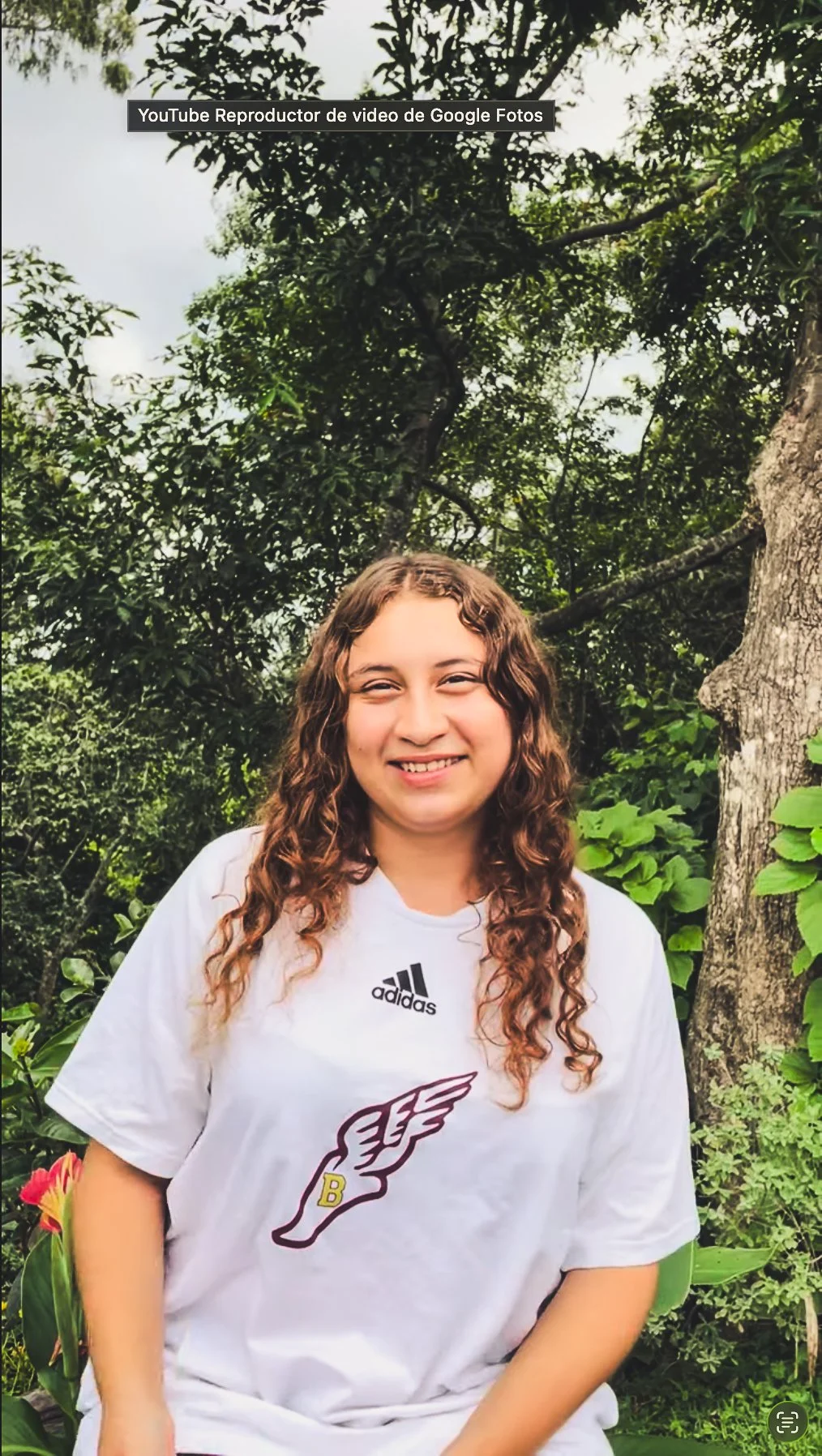
My name is Verónica Avilés. I am 20 years old and come from El Papaturro, a community in Suchitoto, El Salvador. It is where I have lived and grown up. The community is surrounded by nature and two rivers. The weather is warm, but bearable. To me, it is a beautiful community that has gone through difficult times but has also learned how to recover.
I do not remember one exact moment when I decided to become involved in my community. I see it as a process. I grew up watching women and men participate in different spaces, make decisions, and consider what could benefit other people.
Within my family, my grandmother and my sister have been my strongest role models. They taught me that we learn through experience and that we should be willing to support community projects because their results benefit all of us.
When I was nine, I began participating in radio and theater activities. I enjoyed performing plays and dialogues, but these were also spaces where I could express what I felt and thought. We could bring what we knew to the stage and represent our community.
Years later, I began accompanying my sister to the El Papaturro Ecological Committee. Young people had created the committee in 2009 to promote changes in how the community managed waste and cared for its trees and rivers. I liked the work and decided to join.
During my first years, I participated as a member. We were young people organizing activities and talking with others about caring for the environment. Over time, I have observed some changes: cleaner streets, less trash in the rivers, and people deciding not to cut down a tree when it is unnecessary. To me, one of the most important results is that some people have begun making these decisions without waiting for someone else to tell them what to do.
In 2022, I participated in SERES’ Actívate program. I joined because I was interested in learning through games and meeting new people. During the process, I began looking more closely at my own actions: what I was doing, who benefited from it, and what consequences it could have.
It was like realizing, “I am already doing this, but I can also do something else to change things.”
In 2023, I continued with Catalizadores. Through these processes, I understood more clearly that my voice could express what I think and feel while also bringing another perspective to a conversation. I remember that during a reflection session, another participant said that we must be willing to try new things because they can strengthen us and the people around us. That idea is still with me.
After Catalizadores, I made a decision that I remember as one of the first I had fully made for myself: I joined a youth association. I thought, “I can decide to do this, and I am going to do it.”
My participation has not followed a continuous path. For about a year, I stepped away from SERES’ programs because I needed to devote more time to my studies. Later, I found a way to balance my studies with my participation in the organization and was able to return. In 2025, I attended the SERES Annual Gathering.
When I compare the Vero who arrived at Actívate in 2022 with who I am now, I see two versions of myself that complement each other. I have grown and realized that my voice has the power to express what I think and feel, but also to help other people see a situation from another perspective.
In 2025, I took on a new responsibility within the Ecological Committee. As a group, we decided that I could coordinate the committee and represent it before our community organization. We currently have around 13 members.
Coordinating does not mean that the work belongs to me. I represent a process built by young people from different generations. A nearby community has looked to our experience as a reference and, before I traveled to Honduras, requested an exchange to learn more about our work. To me, this shows that a practice developed in one community can help others think through their own responses.
When I finished high school, I was not sure what I wanted to do for the rest of my life. Questions about my future created a great deal of uncertainty. Once I learned to balance my studies with other learning experiences, I began asking myself something different: What do I feel comfortable doing, and how can I use something I enjoy to contribute to the lives of the people around me?
I chose technical training in Tourism because it allows me to connect with people who have different experiences and perspectives. I learned a great deal, and I do not regret making that decision.
I am now beginning another process outside El Salvador. I was accepted as the first Salvadoran student at Leadership Mission International and will spend two years in Honduras, with vacation periods that will allow me to return to my community.
I carry with me what I learned in El Papaturro. In Honduras, I am living and learning alongside women who grew up in different contexts and hold different points of view. I want to learn to speak up more when I encounter situations I consider unjust and to communicate my ideas without attacking what someone else believes. I also want to put my abilities at the service of my community and contribute more to our collective work.
In my experience, learning becomes action when I recognize an ability, decide to use it, and accept a specific responsibility. First, I accompanied my sister to the Ecological Committee. Then I decided to join. Later, I agreed to coordinate it and represent its work within the community.
I would not tell a nine-year-old girl from El Papaturro that she must begin by trying to change everything. I would encourage her to express what she thinks, spend time with other children, and become involved in the programs and activities that already exist. Decisions can begin with something small.
From Honduras, the murals on the kiosk remind me that many community actions begin that way: someone participates, learns from others, and, when the time comes, decides to take on a new responsibility.